
Looking back, I realise that I was practising circular fashion long before I knew the term existed.
As a child, I loved changing and transforming clothes. I was always curious about what something could become rather than accepting it as it was.
One of my earliest memories is my father’s long Russian leather jacket. To me, it looked old-fashioned and far too serious. I had a different vision.
One day, I decided to cut it down and transform it into a short rocker-style jacket.
I still remember the expression on my father’s face when he saw me cutting into his jacket. It was a mixture of shock, disbelief, and perhaps a little fear about what I was doing.
For me, however, it was not destruction.
It was creativity.
And I wasn’t finished.
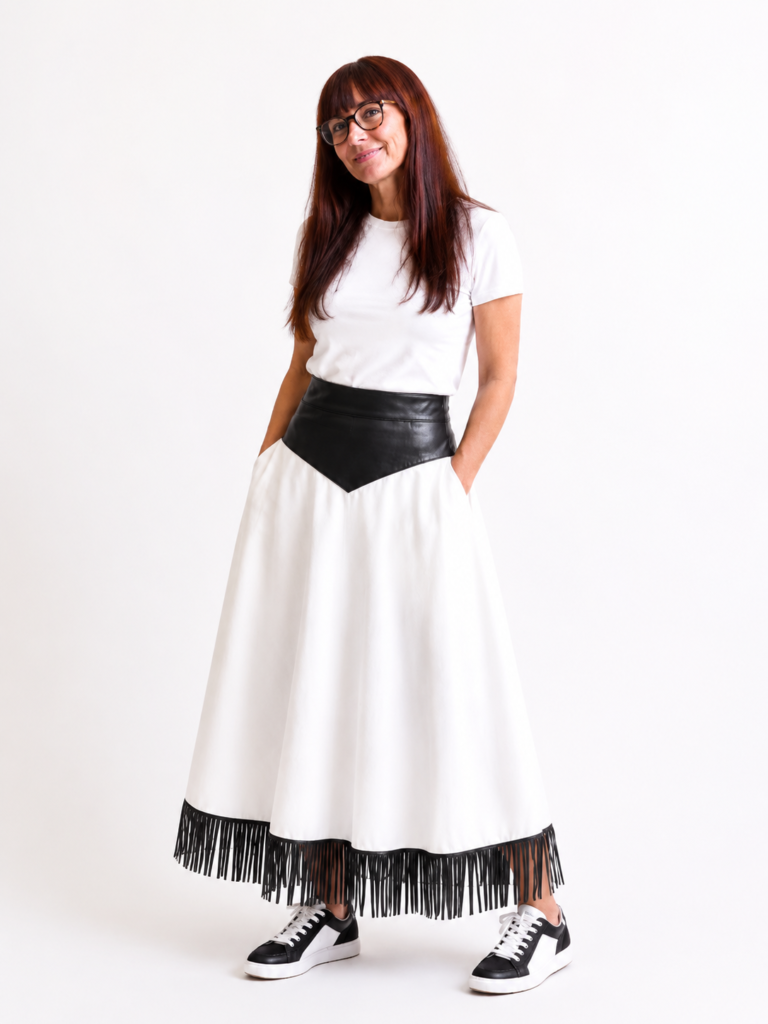
I didn’t want the leftover leather to go to waste. Using the remaining pieces together with an old bedsheet, I designed and made a skirt. At the time, I was heavily inspired by the style of Depeche Mode. I loved the dark, rebellious, alternative look and wanted to create something completely different from what everyone else was wearing.
I even made two skirts – one for me and one for my sister.
We were incredibly proud of our creations.
One day, we wore our matching skirts when we went to the police station to collect my very first ID card.
I still remember the police officer looking at us with surprise before asking:
“Are you from abroad?”
At the time, we didn’t see it as a compliment.
On the bus, people stared at us. On the street, people stared at us. We felt embarrassed and convinced ourselves that the design had been a complete failure.
We rushed home believing we had got it all wrong.
But looking back now, I see the situation very differently.
Those stares weren’t rejection.
They were attention.
People noticed us because we looked different.
What we thought was failure may actually have been one of the greatest compliments we could have received.
Without realising it, we had created something original enough to stop people in their tracks.
As I grew taller, my trousers often became too short. Instead of throwing them away, I found ways to extend their life. I would sew different fabrics onto the bottom to create a new design.
The first pair I transformed featured a bold zebra-print fabric.
I remember stepping out onto the street feeling nervous. What would people think? Would they laugh? Would they stare?
They did stare.
But something unexpected happened.
I realised that clothing could tell a story. It could express personality, creativity, and confidence. What began as a practical solution became a form of self-expression.
Without knowing it, I was already following the principles that would later shape my life and career: repair, redesign, reuse, and reimagine.
I wasn’t interested in fitting in.
I was interested in creating something different.
Today, after years of working in fashion, repair, redesign, and circular economy projects, I can see that those childhood experiments were more than just creative play. They were the foundation of everything I do now.
The leather jacket, the Depeche Mode-inspired skirt, the zebra-print trousers, and the courage to wear something different taught me an important lesson:
Waste is often just potential waiting to be reimagined.
If you would like to follow the journey, subscribe to our newsletter.